
The Promise Institute
for Human Rights (Europe) News

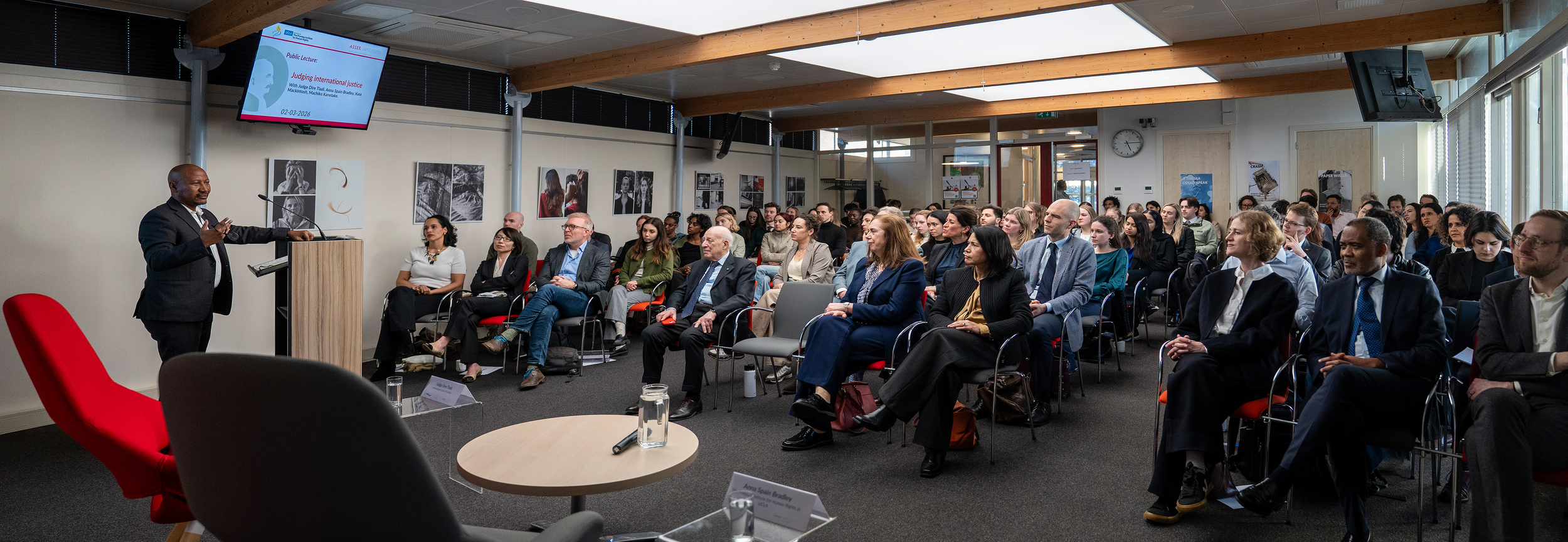
2nd Annual Judging International Justice Lecture featuring Judge Dire Tladi
In his lecture, Judge Tladi examined the role of the International Court of Justice and the contours of its function. He reflected on the interpretation of concepts of jus cogens and erga omnes, situating them within current discussions about the meaning and continued relevance of international legal institutions in a time marked by multiple conflicts and challenges to international agreements.

🌍 Understanding the Elements of Ecocide Law: A Seven-Part Series🌍
Part 6: Creation of Harm or Risk?
Some crimes consist in bringing about harmful consequences, while others consist of creating a risk of harm. These offences of “endangerment,” are committed regardless of whether the harm materialises.

🌍 Understanding the Elements of Ecocide Law: A Seven-Part Series🌍
Part 5: The Mental Element
Mens rea refers to the criminal intent or awareness a suspect has regarding the wrongfulness of their actions. In cases of environmental harm, the issue of mens rea is complex since potential violators rarely aim to cause environmental damage; rather, harm is a byproduct of profit-driven activities.

🌍 Understanding the Elements of Ecocide Law: A Seven-Part Series 🌍
Part 4: The Unlawfulness of Conduct
There is currently a debate over how a crime of ecocide at national level should relate to other environmental laws and regulations. If an act is not in violation of environmental regulations, can it still constitute the crime? This is less relevant at the international level, as the fact that something is permitted under national law does not exclude it from being an international crime.

🌍 Understanding the Elements of Ecocide Law: A Seven-Part Series 🌍
Part 3 : Prohibition of Acts vs Prohibition of Consequences
Most of the new legislation – laws in Belgium and Jalisco(Mexico) and proposals in Mexico (federal), Brazil, the Netherlands, Italy, Peru, and Scotland – describe the crime through the consequences of acts (or omissions), rather than listing prohibited acts. Acts amount to ecocide when and if they threaten or cause a certain level of harm to the environment. The International Proposal takes this approach, prohibiting acts which cause a substantial risk of harm without detailing which actions create that risk.

🌍 Understanding the Elements of Ecocide Law: A Seven-Part Series 🌍
Part 2: The Definition of Environment
As ecocide encompasses harm to the environment, the definition of environment governs what kinds of harm can be criminalized. While there is no accepted definition of the environment in international law, the International Expert Panel for the Legal Definition of Ecocide follows the language of the Environmental Modification Convention to define the “environment” as “the earth, its biosphere, cryosphere, lithosphere, hydrosphere and atmosphere, as well as outer space”.
The International Law Commission and the International Committee of the Red Cross both consider that the concept of the environment includes both human and natural elements as they constitute a complex system of interconnections that cannot be treated as discrete.

April 24: Armenian Genocide Memorial Day
April 24: Armenian Genocide Memorial Day
Today, April 24th, marks Armenian Genocide Memorial Day, an annual day of remembrance for the victims of the Armenian Genocide of 1915. This tragic chapter in history saw the systematic mass killings and starvation of approximately 1.5 million Armenians by the Ottoman Empire, motivated by ethnic and religious intolerance.
The Promise Institute was founded in honor of those who perished, to work towards a world in which such atrocities are never repeated.

🌍 Understanding the Elements of Ecocide Law: A Seven-Part Series 🌍
Part 1: The Treshold Of Harm
This series breaks down the seven key elements of adopted and proposed ecocide legislation, why they matter and how they have changed in comparison to the international proposal.
Xuchen Zhang and Kate Mackintosh conducted an extensive comparison of existing and proposed laws. In this series, we present their findings in bite-sized pieces, examining each element in detail to highlight its significance.
A Practical Guide for Transposing the ECD’s Qualified Offence
A Practical Guide for Transposing the ECD’s Qualified Offence
EU Directive 2024/1203 on the protection of the environment through criminal law (ECD) came into force on 20 May 2024. It requires all EU Member States to introduce national laws addressing environmental crimes, including the most serious cases—so-called “qualified offences,” which may closely resemble ecocide.

Human Rights at Sea: Contemporary Challenges
Our Legal Associate Amanda Brown, a doctoral researcher at SOAS University of London, joined the expert panel on Human Rights at Sea: Contemporary Challenges, co-hosted by the Hellenic Branch of the International Law Association and the Athens Public International Law Center, where she spoke about the challenges of documenting human rights violations at sea, with a specific focus on Greece’s systematic practice of expelling asylum seekers into Turkish waters.

Ecocide Law Advisory Launch
On February 12, we gathered at the Asser Institute in The Hague for the launch of Ecocide Law Advisory (ELA) and the Manual on the National Criminalisation of Ecocide—two initiatives dedicated to advancing the effective criminalization of ecocide at national and international levels.

Annual Report 2024
We invite you to explore our annual report, a dynamic digital magazine highlighting the many significant events of the past year. From fostering global collaborations to driving meaningful change: we’re proud of the progress we’ve made together.

Executive Director Kate Mackintosh represents the State of Palestine at the ICJ
We are very proud that the Executive Director of the UCLA Law Promise Institute Europe had the honour of appearing before the International Court of Justice (ICJ) on behalf of the State of Palestine, alongside Ambassador Ammar Hijazi and Professor Nilufer Oral. Together, they argued that state responsibility for climate change must encompass the climate impacts of armed conflict and occupation.

🌍A Fifth Crime of Ecocide: Opening Considerations
The recordings of this event are now available in English and French. They will soon be available in Spanish as well.
We are delighted to share the link to the recording of the incredible event organised by Stop Ecocide International, hosted by the Republic of Vanuatu, Samoa, Fiji, and the Democratic Republic of Congo and co-organised by Climate Counsel and the UCLA Law Promise Institute Europe.

The ICJ’s Advisory Opinion: A Potential Game-Changer for Climate Accountability
This December, the International Court of Justice (ICJ) begins hearings on a historic request for an advisory opinion on climate change.
These proceedings represent a pivotal moment for global climate governance, offering the potential to clarify States’ legal responsibilities to address the climate crisis.
In anticipation of this critical moment, our May conference brought together experts and advocates to explore the very issues now taking center stage in The Hague.

‘Ambition as a Benchmark’: The Fight for Climate Justice at the ICJ
“Since about four years ago, I can count the times we’ve been told that what we’re trying to do is too ambitious. But with the UNGA resolution adopted by consensus, and over 90 states’ and IO submissions before the ICJ, I guess ‘ambitious’ has become the benchmark for us. So if it seems too ambitious, that must be the way to go, precisely because what we need is more ambitious action.”
Nicole Ponce - Environmental and human rights lawyer-advocate

Legal recognition alone is not enough; it must lead to accountability and real-world solutions!
“The pending advisory opinions on climate change are excellent opportunities to reinforce the clear duties of States to protect the human rights of all people, without discrimination, against the devastating impacts of the climate crisis.”
-Volker Türk - United Nations High Commissioner for Human Rights

Small Island States and the Fight for Climate Justice
Small Island Developing States (SIDS) are among the least responsible for climate change but face its most severe consequences, including rising sea levels, extreme weather events, loss of biodiversity, and even the existential threat of submersion. In response to this crisis and the international community’s inaction, COSIS was established in 2021 by Antigua and Barbuda and Tuvalu, later joined by other SIDS, to amplify their voices in international legal forums. COSIS aims to use international law to protect the rights of SIDS, holding States accountable for their obligations to mitigate and adapt to the effects of climate change.

Rewriting Justice for a Burning Planet: ICC Deputy Prosecutor Khan on the Role of International Criminal Law
In a compelling keynote speech delivered at the UCLA Law Promise Institute Europe, Nazhat Shameem Khan explored the pivotal role international law must play in addressing the pressing ecological crises of our time. Her address emphasized the need for flexibility, innovation, and collective effort to adapt legal frameworks to the realities of environmental degradation and climate change.