
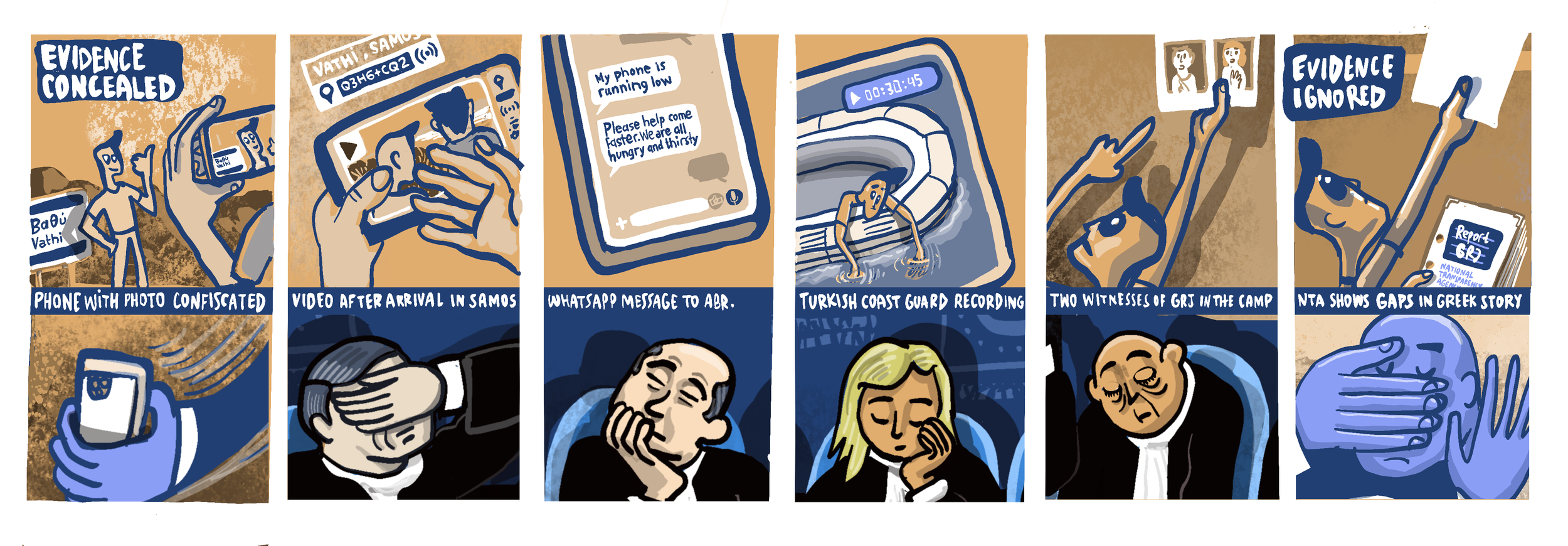
Illustration by Yorgos Konstantinou
UCLA Law students volunteering with The Promise Institute for Human Rights (Europe) helped prepare a case that has been filed with the UN Human Rights Committee by G.R.J., a young man from Afghanistan. G.R.J. was 15 years old when Greek officials abducted him from a refugee camp on the island of Samos, forced him onto a Coast Guard vessel, and then abandoned him at sea on a life raft.
G.R.J., whose name is anonymized for his protection, asks the Committee to find that Greece violated his rights under the International Covenant on Civil and Political Rights (ICCPR). He had first brought his case to the European Court of Human Rights (ECtHR) in Strasbourg, which in 2025 declared it inadmissible for insufficient evidence, despite the extraordinary evidence he had gathered. With Strasbourg having refused to examine the merits of his case, he now turns to the UN Human Rights Committee (HRC) in an effort to have his case heard in full.
He submitted his complaint with the support of the European Center for Constitutional and Human Rights (ECCHR); the Human Rights Legal Project (HRLP) on Samos; Dr. Niamh Keady-Tabbal, legal consultant for the Global Legal Action Network (GLAN); Flip Schüller of Prakken d’Oliveira; and Amanda Brown (UCLA Law ‘20), legal advisor at the Promise Institute (Europe). Supervised by Brown through the Promise Institute’s pro bono program, 23 UCLA Law students provided legal research support for the case.
‘Drift-backs’ at sea: A systematic practice by Greece
Greece and other EU states have been documented carrying out pushbacks for decades. In a pushback, people are forced back across a border without any assessment of their individual circumstances or any opportunity to seek asylum. In early 2020, Greek authorities began using a method that would become known as a ‘drift-back’.
In a typical drift-back, an asylum seeker is either intercepted at sea or abducted from land, taken to the Turkish maritime border, and left adrift in an inflatable non-navigable raft or immobilized boat. As with all pushbacks, these expulsions are done off the record, without a paper trail, and phones are confiscated, leaving survivors with little ability to show what happened to them.
G.R.J.’s case, first documented by the NGO Aegean Boat Report, is one of the earliest verified cases in Forensic Architecture’s ‘Drift-backs in the Aegean Sea’ database. Between 2020 and 2023, Forensic Architecture documented more than 2,000 drift-back incidents in the Aegean Sea, involving the expulsion of over 55,000 people, sometimes causing deaths and disappearances at sea.
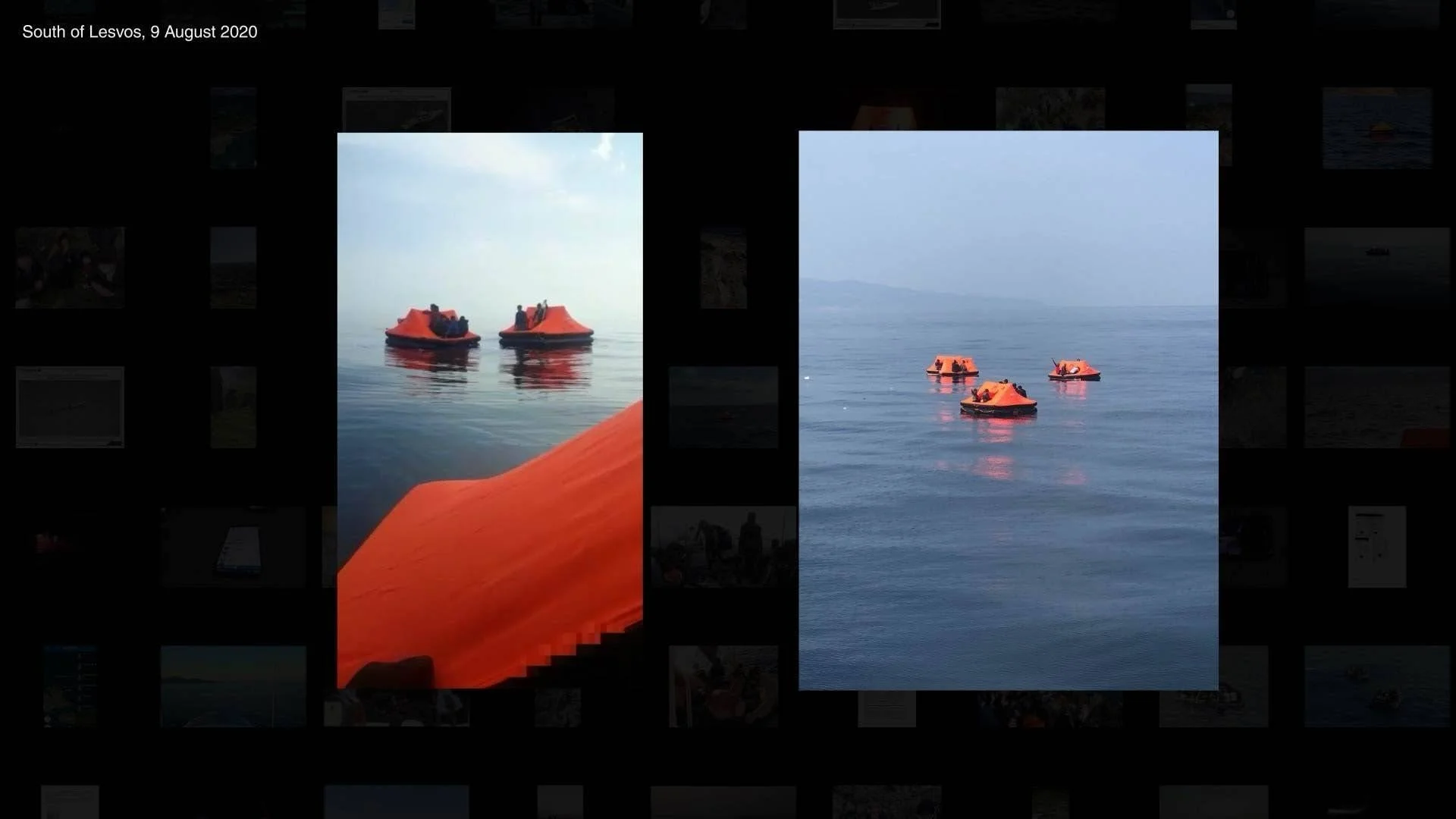
Image from forensic architecture
G.R.J.’s story
G.R.J. is Hazara, one of the most persecuted communities in Afghanistan. He was forced to flee his home in 2018, a year of record Taliban attacks, and crossed Iran and Türkiye on his own as an unaccompanied minor. In neither country could he apply for international protection or legal status, and he lived in constant fear of deportation.
In September 2020, aged 15, he crossed from Türkiye to Samos on a rubber dinghy with a group of other Afghan asylum seekers. The group landed on a remote, rocky stretch of coast. Some were unable to continue on foot, so G.R.J. and another unaccompanied teenager went to look for help. They walked until they reached the island’s refugee camp, where they told Greek officials they wanted to apply for asylum.
But rather than registering their asylum claims, the officials told them they first had to be taken into COVID-19 quarantine. This was a lie: they brought the boys out of the camp, put them in an unmarked car and drove them to the port, where they were forced onto a Greek Coast Guard vessel. Officers confiscated their phones and money and handcuffed them together.
Out at sea, the boys were put onto a leaking inflatable life raft and then abandoned. It had no motor, no paddles and no life jackets. G.R.J. remembers fearing for his life, as he could not swim and the sea was rough. The two boys paddled with their hands toward the Turkish coast, and the Turkish Coast Guard later rescued them. They later learned that the rest of their group had already been pushed back in a similar operation.
Back in Türkiye, and having been robbed of his phone and money by the Greek officials, the 15-year-old faced homelessness, precarity, and the risk of chain refoulement to Afghanistan, where he could be subjected to torture or other serious harm.
“Greece has a documented practice of pushing Afghan asylum seekers back to Türkiye, and Türkiye has a documented practice of deporting Afghan asylum seekers to Afghanistan, either directly or through a third country,” explained Neeka Mirpour (JD ’28). “By pushing him back to Türkiye, Greece exposed G.R.J. to this risk of chain refoulement, in violation of his right to life and the prohibition of torture under international law. And as a Hazara, a child and unaccompanied, he faced risks that were each serious on their own, and far greater in combination.”
The following year, G.R.J. managed to re-enter Greece, where he was recognized as an unaccompanied minor and was finally granted asylum.
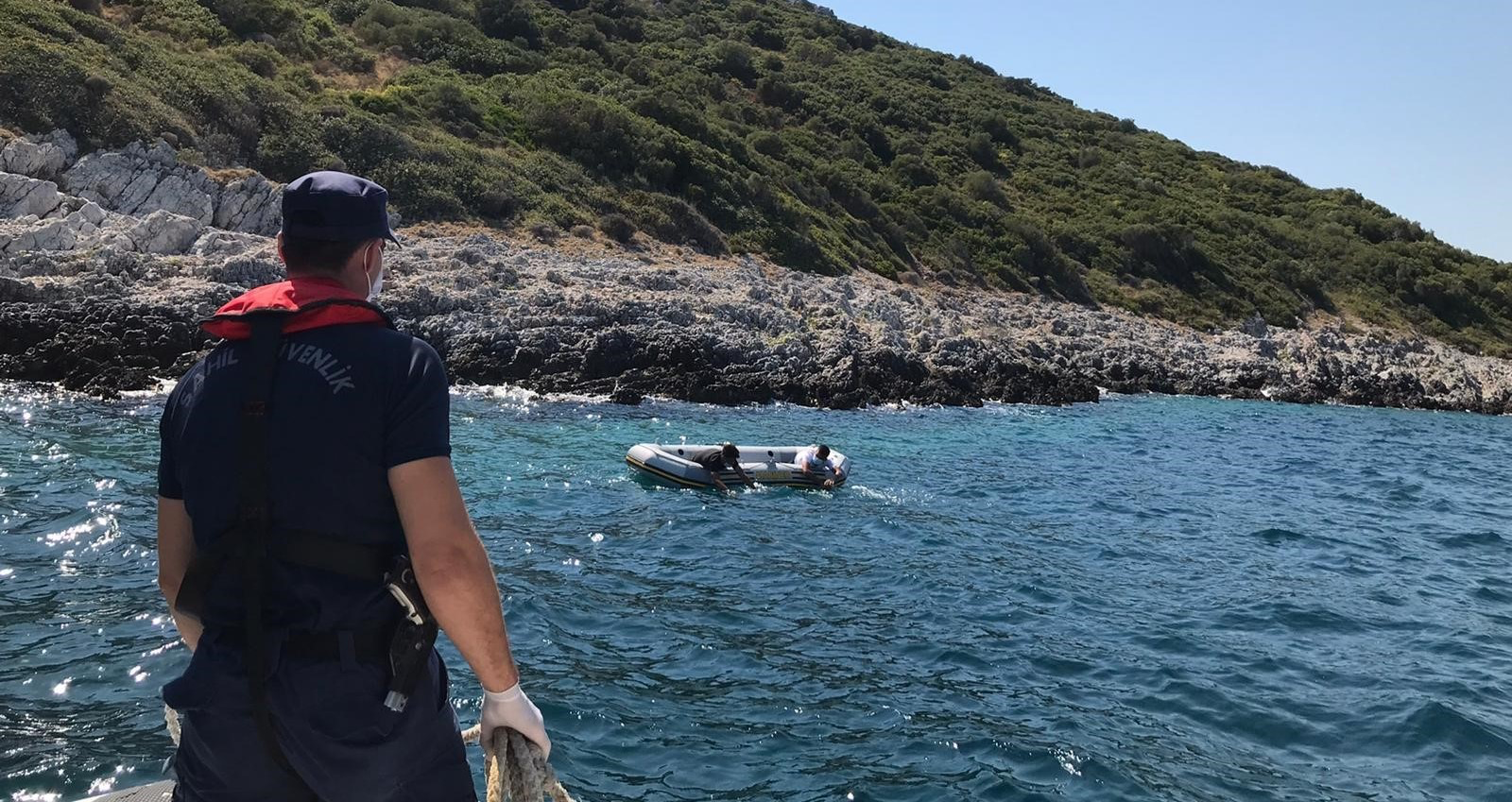
G.R.J.’s rescue
The case of G.R.J. v Greece: “Pushed back” from Strasbourg
G.R.J. brought his case to the European Court of Human Rights in 2021. In June 2024, it became the subject of the Court’s first public hearing on Greek pushbacks, held together with A.R.E. v. Greece, which concerned a pushback across the Evros land border. In its decisions, published in January 2025, the Court recognized for the first time that Greece carries out pushbacks as a systematic practice, and acknowledged that proving a pushback is “extremely difficult” given its “inherently secretive and unofficial nature”. Yet it dismissed G.R.J.’s complaint as inadmissible, finding that he had not sufficiently established that he was one of the victims.
But G.R.J. had far more evidence than most pushback survivors are ever able to keep. The group he traveled with had photos and videos of their arrival on Samos, including screenshots from when they had sent live locations over WhatsApp to Aegean Boat Report. The Turkish Coast Guard published a report of their rescue, with photos and video of the two boys being picked up at sea. Witnesses confirmed seeing him in the camp. A freedom of information request revealed that Frontex, the European Border and Coast Guard Agency, had recorded an incident matching his account.
Even Greece’s own records supported his case. An investigation by the National Transparency Authority found significant contradictions with the account Greece stood by in Strasbourg. Among them were movements of a Greek Coast Guard vessel that matched G.R.J.’s account but had not been properly logged.
Still, the Court decided this was not enough. It accepted that Greece’s account seemed unlikely, and that the pushback may well have happened. Yet instead of treating his detailed, corroborated account as enough to shift the burden to Greece, as it normally would, the Court decided that G.R.J. had not established a prima facie case that he was one of the boys pushed back. In the end, the secrecy it had acknowledged was held against him. Because the case was declared inadmissible, his claims were never examined on the merits, and the decision could not be referred to the Grand Chamber.
“People should not lose their right to justice simply because those responsible for documenting what happened are the very authorities they accuse of violating their rights,” said Danial Haschem (LL.M. ’26). “Overly rigid evidentiary standards in pushback cases effectively grant impunity to State actors. The Human Rights Committee has the opportunity to ensure that such violations are not rendered legally invisible.”
A second chance at justice: G.R.J. v Greece before the UN Human Rights Committee
“Greece has not entered a reservation that would prevent the Human Rights Committee from considering a complaint already brought to another international body,” explained Grayson Rost (JD ’26), who researched admissibility jurisprudence with Ben O’Hara (JD ’28). “The European Court had the chance to examine what happened to G.R.J., but stopped at admissibility,” O’Hara added. “The Committee can now go further and assess the merits of his claims.”
G.R.J.’s complaint to the Human Rights Committee argues that Greece violated his rights under the ICCPR, including:
the right to life (Article 6(1));
the prohibition of torture and cruel, inhuman or degrading treatment (Article 7);
protection against arbitrary and collective expulsion (Article 13);
the right to recognition as a person before the law (Article 16);
the right of every child to the protective measures required by their status as a minor (Article 24(1)); and
the right to an effective remedy (Article 2(3)).
Beyond the individual case, the complaint also asks that Greece take measures to prevent similar violations, by ending its systematic pushback practice and effectively investigating allegations of serious rights violations arising from it.
Some of these protections were not available to G.R.J. in Strasbourg. The European Convention has no equivalent to the right to recognition as a person before the law, or to the ICCPR’s specific safeguards for children under Article 24, which are especially significant for an unaccompanied 15-year-old.
“As the Human Rights Committee has affirmed, States are required to treat a child’s best interests as a primary consideration in every decision that affects them,” explained Sophia Sweeney (JD ’28), who researched Article 24 jurisprudence. “States are supposed to provide extra protection for unaccompanied minors, including by identifying them as children and appointing them a guardian, who could help them navigate the legal system. The State failed to do any of this for G.R.J., and instead put him into an even more precarious situation.”
“It is crucial that the ICCPR includes these extra protections for minors, especially unaccompanied minors, because it is a recognition that children traveling alone are among the most vulnerable people at any border,” added Umiemah Farrukh (JD ’28), who conducted the Article 24 research with Sweeney. “In G.R.J.’s case, the State not only failed to fulfill its duties but weaponized its authority against a child who depended on it for protection, compounding his vulnerability rather than safeguarding his rights at a time when he most needed them.”
The role of UCLA Law pro bono students
Supervised by Brown, the 23 students researched the jurisprudence of the Human Rights Committee and other UN treaty bodies and helped draft potential legal arguments for the complaint. Some brought prior experience in migration and human rights work, while others were engaging with these issues for the first time.
“At the Promise Institute (Europe), we connect students in LA with hands-on opportunities in international human rights law, from international courts and UN bodies to collaboration with NGOs and activists,” said Brown. “Whether they’re pursuing a career in this field, are still finding their path, or simply want to volunteer their time and legal training, there is a place for them in this work, and so much they can learn and contribute.”
“Of everything I’ve done through the Promise Institute and the International and Comparative Law Program, this case matters most to me, because it defines who I am and what I want my legal degree to mean,” said Pelin Ensari (JD ’26), who volunteered with refugees in Istanbul before coming to UCLA. “This case has allowed me not only to apply the skills and knowledge of my legal education but also see that commitment come to fruition.”
Brown, who graduated from UCLA Law in 2020 and is now based in Athens, hopes these experiences show students how many ways there are to challenge rights violations, and how interconnected injustices are. “This pushback happened over 7,000 miles from UCLA, but the racialized exclusion, violence and fortressing we see at Europe’s borders are part of a global system of migration control, with clear parallels in the US,” she said. “In many ways, what happened on Samos is not as far from Los Angeles as it might seem.”
For more on the Promise Institute (Europe)’s pro bono opportunities, visit https://law.ucla.edu/academics/centers/promise-institute-europe.
For the official press release from G.R.J.’s case team: https://www.ecchr.eu/en/press-release/pushed-back-from-europe-and-its-human-rights-court/
For an Opinio Juris article on the case, authored by Brown and three other members of the legal team: https://opiniojuris.org/2026/11/02/pushed-back-from-europe-and-its-human-rights-court-evidence-of-lawless-expulsions-before-the-un-human-rights-committee/