
Unsafe - A 21st Century Poetry of Witness
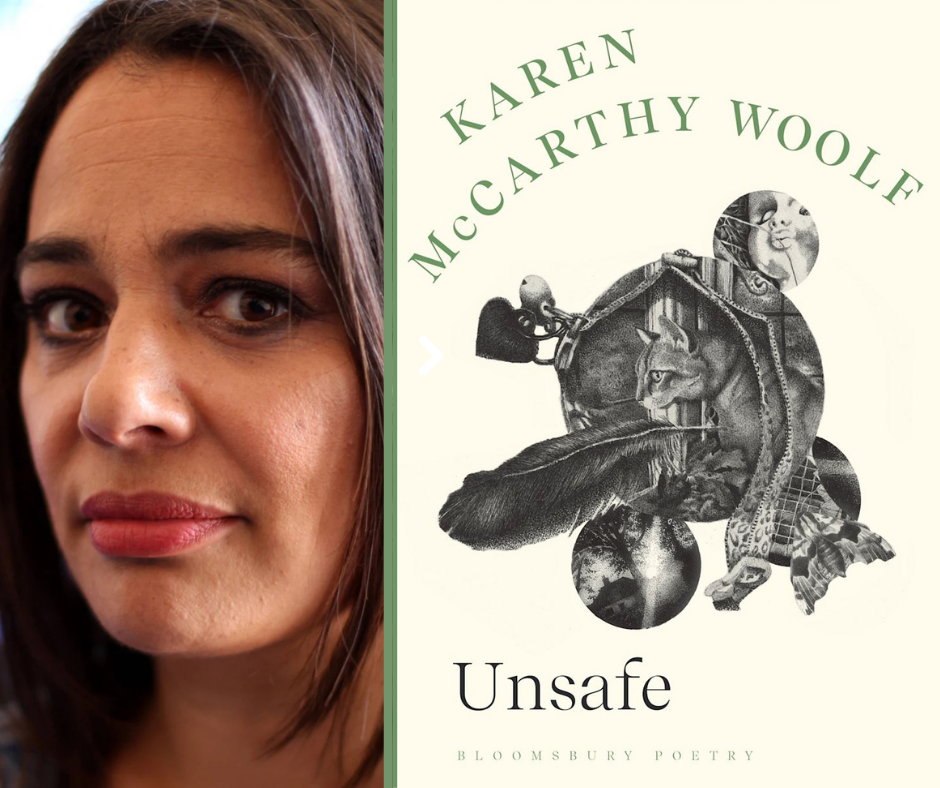
Karen McCarthy Woolf’s new poetry collection Unsafe, published in February 2026, by Bloomsbury, brings together work developed during her residency at The Promise Institute for Human Rights at UCLA School of Law in 2019 and 2020.
As a disenchanted walk through London and Los Angeles, Unsafe shows the effects of capitalism on those who live at its sharp end. It is an immersive meditation on place, the body, nature, and the self, drawing the reader into processes of gentrification and economic disparity, often through unexpected lenses – from trees and tattoos to the totemic qualities of cats.
Combining poetry, documentary, and the micro essay, Unsafe examines what it means to be a citizen and reflects on the spaces that remain free. Karen describes the book as a photolyric, that mixes poetry, prose and her own photography to capture macropolitical issues through renditions of our everyday experiences.
“I am interested in using poetry to speak to our emotional and interior landscapes and thoughts, even, or particularly, within a political framework. ”
Poetry and Law
Much of Unsafe was shaped during McCarthy Woolf’s time as poet-in-residence at the Promise Institute. While poetry and law are not an obvious pairing, they find each other in meticulous attention to language, to nuances of meaning, and in the case of law, its actual and material impact.
Poetry delves under the surface and reaches the emotional core of experience. McCarthy Woolf describes it as a practice that can articulate our deeper feelings and transform both writer and reader.
“Unsafe might be considered a ‘poetry of witness’: it is a way to distill and express complex ideas, to harness music, art and their transformative power, to help people understand and empathise. Increasingly we are finding ourselves having to contemplate multiple, sometimes contradictory complexities and rhetorical conflation at a political level. Law, like poetry, vigorously resists conflation in its relationship to language, to detail, specificity and articulation.
I’m fascinated by how we construct our world and society, by its natural and artificial ecologies, and how this connects to the larger complex web that we might think of as ‘nature’. My poems are often attuned to the natural world, and so Kate’s work at The Promise around ecocide was also compelling.
In Unsafe one of the things I’m thinking about is how to break down and disrupt the sense of hierarchy between the human and the non-human. How what we do to animals, to trees, forests, waterways, mountains is a reflection of how we might treat ourselves and other humans. How the artificial constructs of race, gender and class as discriminatory agents affect everyone, everywhere. UCLA is the academic home of intersectionality and Unsafe is an inherently intersectional text. I also found Professor Ruth Wilson Gilmour’s work on carceral abolition very inspiring in terms of how we might shape our thoughts around art, literature and activism.”
An Artistic Perspective on Human Rights
For Kate Mackintosh, Executive Director of the Promise Institute at the time, inviting McCarthy Woolf was a deliberate decision:
“Karen looks at some of the world’s most pressing problems through an uncommon lens, illuminating new avenues of progress in human rights. Poetry also connects on an emotional level, helping us feel as well as think about human rights and social justice.”
Her time at UCLA Law gave Karen a greater understanding about how the power of storytelling matters in the wider world.
“Working with The Promise Institute made me realise how in its more exalted form, law strives to be impartial, and by extension fair. Robust human rights law needs to consider things from many angles, which is something I also do in my poetry.”
The collaboration created space to approach human rights work from a different perspective, bringing artistic and legal practices into dialogue and into the classroom.
“One of the things I enjoyed most was working with law students to make collage/erasure poems about their experiences working in bail bond reform. I think poetry gave them the opportunity to process the emotional residue around the work. To share their feelings, as well as their thoughts; to use art and poetry as a means by which to validate emotion as a critical response alongside the rigorous intellect that lawyers deploy.”
About the Author
Dr Karen McCarthy Woolf, FRSL, PhD, is the author of three poetry collections and editor of seven literary anthologies. Her novel in verse, Top Doll, was shortlisted for the T. S. Eliot Prize, and her debut, An Aviary of Small Birds, was an Observer Book of the Year.
As a Fulbright Scholar at UCLA, she was poet-in-residence at the Promise Institute for Human Rights, where she wrote Unsafe (Bloomsbury, 2026). In 2025, she received the Society of Authors Cholmondeley Award and the Jerwood Prize for Poetry.
Unsafe can be purchased worldwide directly from Bloomsbury Publishing and londonreviewbookshop.co.uk. It is available as a paperback, ebook and audiobook. You can follow Karen on Instagram and LinkedIn or visit her website mccarthywoolf.net.