
The Promise Institute
for Human Rights (Europe) News

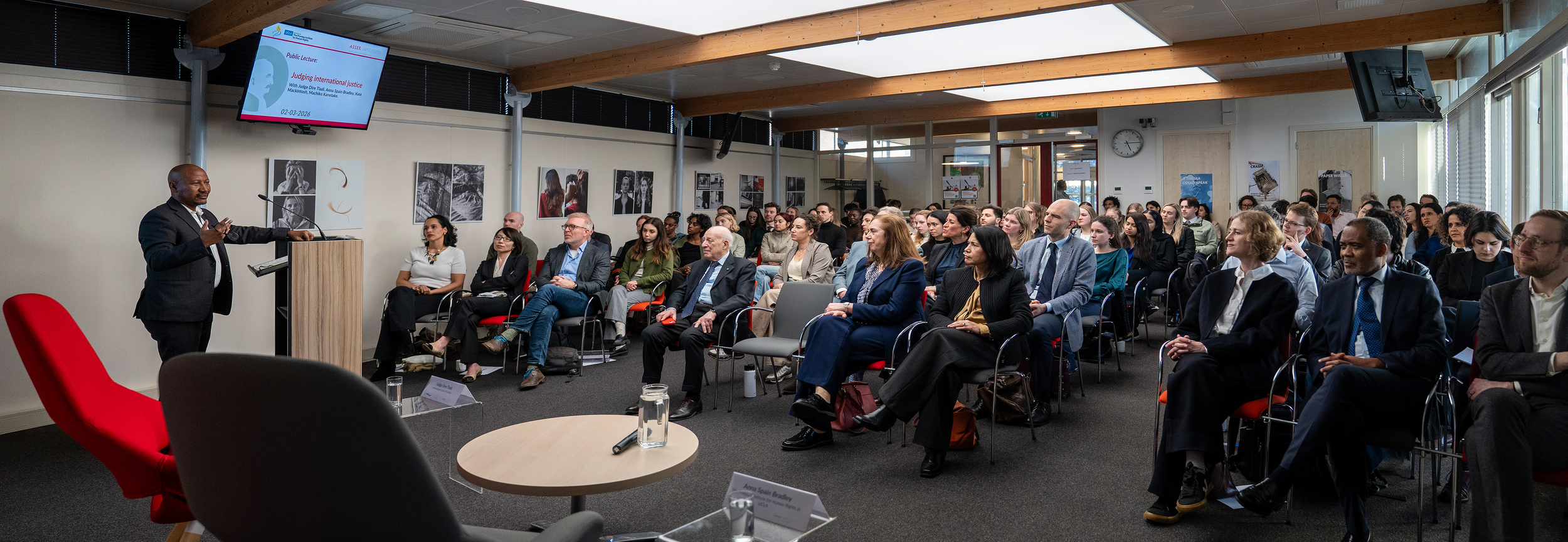
2nd Annual Judging International Justice Lecture featuring Judge Dire Tladi
In his lecture, Judge Tladi examined the role of the International Court of Justice and the contours of its function. He reflected on the interpretation of concepts of jus cogens and erga omnes, situating them within current discussions about the meaning and continued relevance of international legal institutions in a time marked by multiple conflicts and challenges to international agreements.

Meet the Speakers: Lovleen Bhullar and Co-Author Gita Parihar
Dr Lovleen Bhullar is Assistant Professor in Environmental Law at the University of Cambridge, as a speaker at our upcoming conference in London on 31 October.
Dr Bullar, together with Gita Parihar, a senior legal consultant specialising in environmental and human rights law, has co-authored the paper “Reviving India’s River Goddesses: Ecocide, the Right to a Healthy Environment and Rights of Nature”.
Their work explores the synergies between the proposed international crime of Ecocide, the right to a healthy environment, and the rights of nature.

UCLA Law in The Hague Students visit Geneva
The UCLA Law in The Hague students are spending this week in Geneva!
On Day 1, the students were able to watch the UN Human Rights Council consider reports on unilateral sanctions, mercenaries and the right to water – and grab a photo with long-time Promise Institute collaborator Pedro Arrojo-Agudo, the UN Special Rapporteur on the Human Rights to Safe Drinking Water and Sanitation! They also visited non-profit International Bridges to Justice, and finished the day with a traditional Swiss cheese fondue.

UCLA Law in The Hagues Students present at UC Alumni reception!
We were delighted to join the community reception and forum for University of California alumni, students, and friends in the Netherlands at the 25th anniversary celebration of the study abroad exchange of UC and Utrecht University!

Meet the Speakers: Daniel Adjin Odonkor
Daniel Adjin Odonkor is a lawyer and researcher with the Centre of Criminology at the University of Cape Town, where his work explores the intersection of criminal law, human rights, and social justice.
Daniel proposes an innovative solution through a "hybrid" definition of ecocide, that balances environmental protection with human rights.
His approach addresses developing nations' concerns about restricting their growth while maintaining robust environmental protections.
The conference can be attended in person and online.

Ecocide Bibliography Highlight
In The First Ecocide Treaty? (EJIL:Talk!, June 2025), Daniel Bertram traces the shifting legal definitions of ecocide from the 1970s to today, advocating for a definition that is both flexible and forward-looking. His analysis emphasises the importance of including reckless acts and omissions, while cautioning against rigid cost-benefit limitations.

Two Inspiring Books for Late Summer
Nature Matters, edited by Mona Arshi and Karen McCarthy Woolf, gathers African, Asian, and Caribbean diaspora voices to reimagine environmentalism and ecopoetics. Woolf, our 2020 Poet in Residence at the UCLA Promise Institute, explored the intersections of poetry, law, and capitalism’s impacts on marginalised communities.
In A Barrister for the Earth, pioneering barrister Monica Feria-Tinta takes us behind the scenes of landmark legal cases defending rivers, forests, and endangered species. Feria-Tinta, a distinguished speaker at our 2024 launch conference, shared insights into the groundbreaking ITLOS Advisory Opinion on climate change.

Neglected Climate Impacts of Armed Conflict addressed by US Judge Cleveland
The landmark opinion handed down by the world’s highest court on Wednesday sets a new framework for legal efforts to address the climate emergency.
We were delighted to see the neglected climate impacts of armed conflict addressed by US Judge Cleveland in her Declaration.

Historic Advisory Opinion on Climate Change
Our ED Kate Mackintosh was in the courtroom of the International Court of Justice yesterday to hear the delivery of the historic Advisory Opinion on Climate Change. Among other significant findings, the Court held that States are under a binding legal obligation to protect the climate system; that there is a right to a clean, healthy and sustainable environment which is essential for the enjoyment of other human rights, and that the principle of non-refoulement applies to people who have been forced to leave their country due to climate change.
The Inter-American Court of Human Rights' New Advisory Opinion on Climate
🚨 Late last week the IACtHR issued a landmark Advisory Opinion on the climate emergency and human rights. The Opinion marks a major step forward in articulating the ways the climate emergency is related to human rights harms. Crucially, the Opinion also* establishes obligations and standards which States must meet in response to the climate emergency — obligations set according to the standards of international human rights law. 👏👏👏

GHF Food Distribution Shootings are a Potential Crime of War
The shootings at the GHF food distributions in Gaza, at which over 500 people have already been killed and thousands injured, are a violation of core humanitarian principles and can be considered a potential war crime, says our Executive Director Kate Mackintosh.
In an interview with Al Jazeera this morning she warns that GHF staff may be complicit in these war crimes and could potentially be prosecuted by many states around the world.

Borders and Belonging discussion at the International Institute of Social Studies
Immigration is a broad and complex topic. With his book Borders and Belonging, Professor Hiroshi Motomura offers a framework that helps deepen the conversation and foster meaningful dialogue, identifying the overlapping but distinct claims of humanity and belonging.

Stop ecocide in the ocean!
Our Executive Director, Kate Mackintosh joined a distinguished gathering in the margins of the United Nations Oceans Conference in Nice to discuss the importance of creating a crime of Ecocide.
Hosted by the states of Vanuatu and the Democratic Republic of the Congo, the event included ministers, government officials and MPs from Ghana, Guatemala and Tahiti, united in their commitment to end the destruction of our shared environment.

Ecocide Bibliography Highlight
Ecocide in Peru: Repsol and the Colonial Regime of Permission, Ignasi Bernat Molina, Environmental Politics (May 2025).
This paper examines the 2022 Repsol oil spill in Peru as a case study, demonstrating how the disaster resulted from long-term decisions by both Spanish and Peruvian states. It argues that ecocide must be understood within a colonial matrix that enriches fossil capital while creating conditions for ecological destruction.

Ecocide Bibliography Highlight
Thanks to the stellar work of our research assistants Ava Schuster and John Dover, our annotated bibliography on international criminal law and environmental protection is fully updated! We’re excited to share the most powerful reads we have come across. Today’s highlight:
The Destruction of Indigenous Communities’ Landscapes: An Aggravated Form of Ecocide? Jérôme de Hemptinne & Helena Szczupak, EJIL:Talk! (May 2025)
This piece explores whether peacetime industrial destruction of Indigenous landscapes constitutes an aggravated form of ecocide.

BBC Radio Scotland Interview Ecocide Bill
Our Executive Director Kate Mackintosh was honoured to assist Monica Lennon as a member of her expert advisory committee. She spoke to BBC Radio Scotland to explain the bill.

Seminar Invitation: Borders and Belonging – Toward a Fair Immigration Policy
Date: June 12, 17:00 – 21:00
Location: International Institute for Social Studies (ISS), The Hague
Please join us on June 12 for a seminar featuring UCLA Law Professor Hiroshi Motomura, who will present his most recent book:
Borders and Belonging – Toward a Fair Immigration Policy

🌍 Understanding the Elements of Ecocide Law: A Seven-Part Series 🌍
Part 7: Liability of Legal Entities, Corporate Workers and Public Servants
Some new ecocide laws create liability for companies as well as individuals. These include those in the EU, Belgium and France.
This means that the legal entity as a whole, as opposed to natural persons within it, can be held accountable for environmental harm. This is important at the national level, where individuals might hide behind the “veil” of the corporate structure to avoid liability.

🌍 Understanding the Elements of Ecocide Law: A Seven-Part Series🌍
Part 6: Creation of Harm or Risk?
Some crimes consist in bringing about harmful consequences, while others consist of creating a risk of harm. These offences of “endangerment,” are committed regardless of whether the harm materialises.

🌍 Understanding the Elements of Ecocide Law: A Seven-Part Series🌍
Part 5: The Mental Element
Mens rea refers to the criminal intent or awareness a suspect has regarding the wrongfulness of their actions. In cases of environmental harm, the issue of mens rea is complex since potential violators rarely aim to cause environmental damage; rather, harm is a byproduct of profit-driven activities.

🌍 Understanding the Elements of Ecocide Law: A Seven-Part Series 🌍
Part 4: The Unlawfulness of Conduct
There is currently a debate over how a crime of ecocide at national level should relate to other environmental laws and regulations. If an act is not in violation of environmental regulations, can it still constitute the crime? This is less relevant at the international level, as the fact that something is permitted under national law does not exclude it from being an international crime.